
How my mind works.
Something happened the other day that is a good illustration of how I work, so I wanted to write it down to give you an idea of how my mind works and how I get my ideas.
I enjoy working in series because it allows me to delve deeper into an idea and gives my work a structure that increases my credibility and recognition as an artist. I am always on the lookout for opportunities to exhibit my work. If I find an exhibit that will help my artist career by getting my work in front of interesting people, I want to participate.
I have two basic series: architecture quilts and my Not What I Taught You series. Two exhibits were being planned, and I wanted to enter a quilt. One was Built to Last, an exhibit at The Peale Museum in Baltimore. It is an exhibit that shows artist interpretations of different Baltimore landmarks. It was easy to decide what to do.
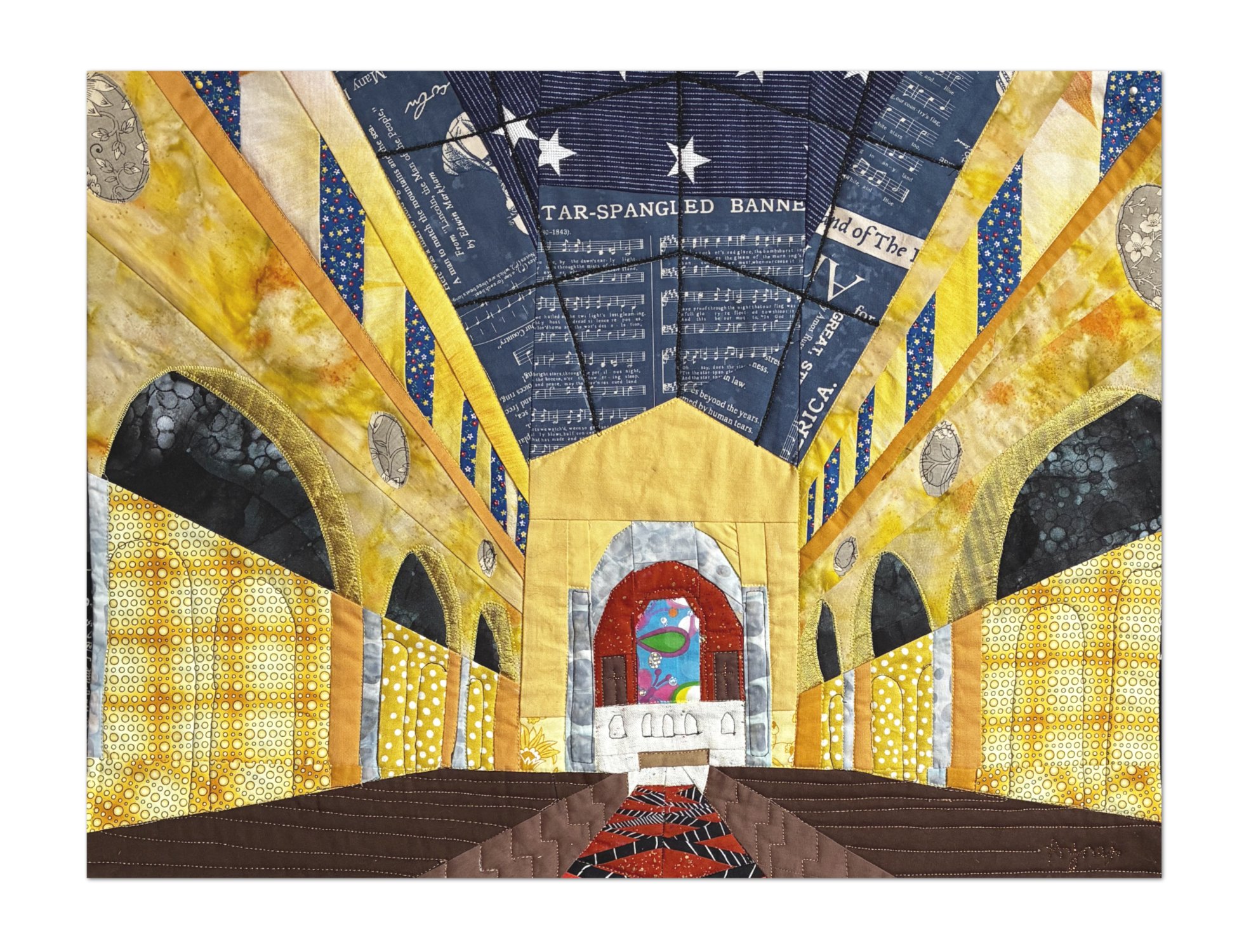
Old St. Paul’s Episcopal Church
There was another exhibit I wanted to enter, and it was trickier to develop an idea for this one. Strathmore is organizing an exhibit around “Tea.” It intrigued me because it is an odd concept for an exhibit. I also thought that Strathmore is a great venue, and there probably would not be that much competition for an exhibit about tea. The idea kept mulling around in my head. I want to make more work for my Not What I Taught You series. I started to think of ideas that had to do with tea that could be part of the series. The series has a lot of American history and monuments viewed in today’s terms. What in American history has to do with tea? Duh. The Boston Tea Party! Then I started thinking, what about the Boston Tea Party could be applied to the present American society?
The Boston Tea Party happened because the colonies were revolting against England for unfair policies. Wait a minute… Puerto Rico is a colony of the United States. What would a revolt like the Boston Tea Party look like in Puerto Rico?
Speaking of unfair polices, enter The Jones Act of 1921. The Act mandates that all goods shipped to Puerto Rico be transported on U.S.-built, -owned, and -operated ships. If we buy something from Dominican Republic, the island next to us, it has to be shipped from DR to the US unloaded and loaded on a US ship and then taken to PR. Since we are an island and everything is shipped, imagine how much that adds to the price of everything. Because we are a colony, we can’t do anything about it.
Back to my quilt musings… In a revolt, they couldn’t push cargo containers into the sea, but they could destroy the shipments with bombs… At the same time that I am thinking about this quilt, the whole Bad Bunny Super Bowl controversy is going on. I’m seeing jibaros everywhere. A jibaro is a traditional, rural Puerto Rican farmer that is a symbol of our national identity. That is how the San Juan Tea Party quilt was born.
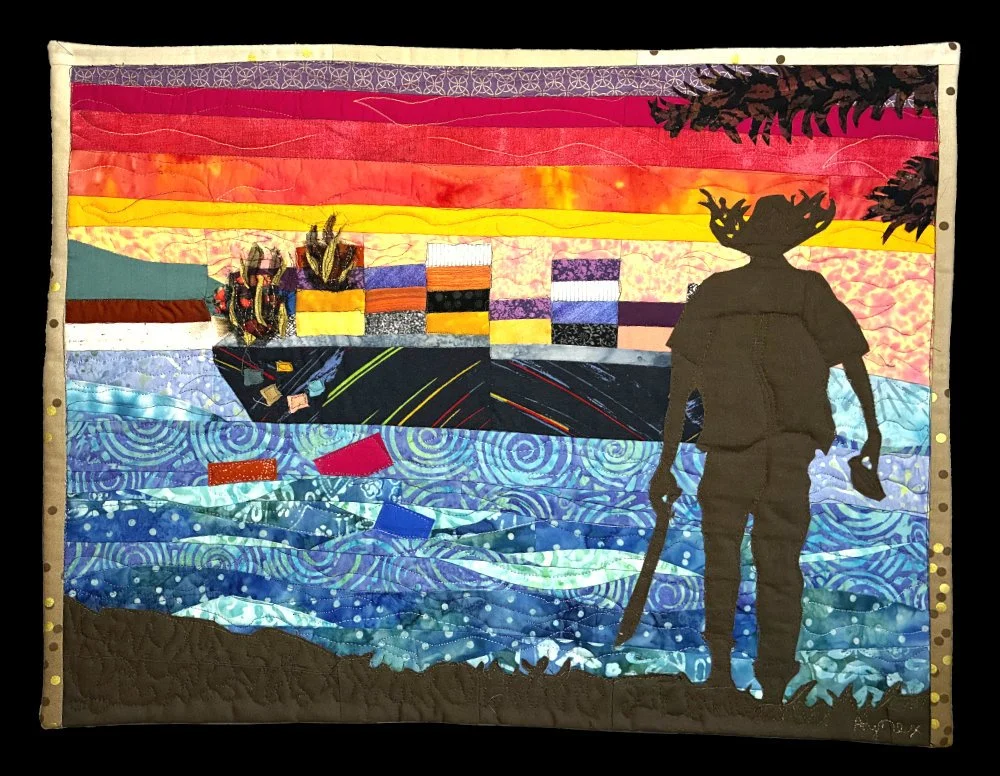
San Juan Tea Party
Creating work for a specific exhibit is a gamble because you never know if you are going to be selected to be in the exhibit. The combination of the complex backstory of the San Juan Tea Party quilt and the fact that it is a quilt and not a traditional painting made me less than certain that it would be accepted. Would they understand the meaning of the quilt? Even if they do, would they think it would be a good fit for the exhibit where everything will probably be pretty floral paintings?
Fortunately, they understood the message and liked it enough to include it in the Steeped exhibit at The Strathmore in March! The Old St. Paul’s Episcopal Church quilt will also be on exhibit at The Peale in April!
Now you see how my brain works. This process is about a month of messaging an idea in my brain until a final design comes out in a quilt. A month of thinking about it while I’m taking a shower or before falling asleep. Then another month of actually doing the work. Figuring out how I can translate what I see in my head into fabric in a way that conveys what I want to say and looks good and well-made.